

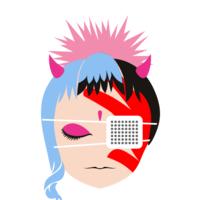
This the second part of our two-part interview with Canary Complex. Click below to read Part One.
A Western artist that captures the sounds of Japanese visual kei.
Personally, I think this album is the first that “sounds visual kei” from start to finish. Was that intentional?
Yes—completely intentional. I'm sure it's obvious to any listener that my previous albums were heavily inspired by visual kei, but I didn't know quite how to achieve this hyper specific sound that I associate with the bands of that place in time.
I have always worked with a DIY approach—I was the only one to touch ANYTHING on the first album When I Say Rain. I didn't quite know how to achieve all of my grandiose visions at the time, so the album emerged very muted and grayscale in tone, which wasn't intentional but seems suiting.
On my second album The Tragic Dance of Dying Leaves, I still wrote and recorded entirely in isolation but I enlisted the help of Michael Rumple with mixing and some of the drums. He did an immaculate job with the material that I provided him, but was limited by the quality of the audio files I recorded in my bedroom studio.
In writing this record, I decided to create something that didn't just reference visual kei, but lived and breathed within its paradigm, without any sacrifices to my authenticity as a songwriter. With A Whisper of Spring, I gave myself permission to step fully into that world—to fully embrace the theatricality, the melancholy, the elegance, the longing as a means of expression.
I enlisted Michael's help as co-producer from day one, and in using better equipment and intentionally analogue-style restrictions on our recording techniques, we emerged with what I feel is equally as forward-thinking as it is referential to an era that's no longer with us. It isn't just an influence on this album... visual kei is her skeleton, her pulse, her perfume.

In your opinion, what kinds of elements make up a “visual kei sound”?
It's a difficult thing to pin down, because it's more spirit than structure, and varies wildly from band to band and scene to scene. But I think 1990s~2000s era of visual kei conveys a sense of longing in its melodic choices and the way they interact with the chord progressions—a romanticism, even when the music is heavy, angsty or dark. There's often a melodic sensitivity, a willingness to embrace beauty, dissonance, and drama without shame.
Also, there was a trend for bands to use a combination of ethereal clean chorused guitars together with VERY high-energy drums and bass. Generally in visual kei, I find that when the drums and bass are punk or metal-influenced, they are more sassy and flowy than they are rough and masculine. There is a melodic contrast in all of this that is very uncommon to hear in Western music.
Very lyrical and blooming bass lines are a key element of visual kei as well. For many years I was a bassist, long before I was a guitarist. I have always been inspired by the ways bassists (for example J of LUNA SEA and Tetsu of L'Arc~en~Ciel) design parts that thoughtfully weave in and out of focus between the drums and the guitars. There is the perception in the West that bass should be perceived and rarely heard. That ethos is valid, but is not a part of my musical landscape. Please listen to the bass, and enjoy it!
Of course, one of the most obvious unique aspects of visual kei is the vocal. I sing in English, because I can connect with my intended emotions in the only language I am fluent in. However, English is phonetically and structurally a very different language from Japanese—and so in the past it has been quite difficult for me to channel influence from my favorite visual kei bands into my singing style.
However, Michael and I (Michael is also a singer—a much better one than me) studied the tendencies of our favorite vocalists and identified the very specific ways we can sing in ways more influenced by them while still singing in English—and without ever adopting any sort of inauthentic accent.
It's difficult to explain in written word, but the most important piece for me personally is focusing on the resonance of my voice. For me to sound the way I want to, I have to allow it to resonate in a very specific part of my chest when singing purely, and releasing all weight from my (naturally deep) voice when going to high notes or falsetto. It isn't hard to do this, but I had to unlearn a lot of developed habits that were always keeping me from fully channeling my influences.
It isn't only songwriting and instrumentation—production choices are a huge part of this sound as well. The ways in which these albums were produced through the 1990s is fundamentally disparate from their Western counterparts.
For example, the drums on EDEN by LUNA SEA are mixed in a strange and obtuse way, but they pump so much energy into the songs. Every mixing choice was very intentional. They're very present and snappy without ever taking up too much room in the frequency spectrum, so the vocals and bass can effortlessly stand out in the mix and be quite loud. In many ways, that's the thread that ties it all together.
How did you come to love visual kei? Who are some of your visual kei heroes?
I found visual kei as a teenager on YouTube, like so many of us did. I was on a deep dive after watching Rurouni Kenshin (るろうに剣心) and wanting to find more music like HEART OF SWORD by T.M.Revolution. Falling deep into a rabbit hole (song after song), eventually I found Satsuki (皐月) by Kagrra, and it was like stumbling into a secret garden.
Back then, I had no idea what elements made it feel like a spiritual connection... although now I could easily define what those traits were. This was all just so much more vivid and exciting than anything I heard before it. I passively played bass and a bit of guitar before this moment, but after it I finally felt inspired and had a raison d'être.
The first band that really gripped me after that experience was LUNA SEA, particularly their first three albums, and the first two albums by L'Arc~en~Ciel. That shimmering iridescence. Then it was the dreamy impressionistic gardens and boulevards of MALICE MIZER and LAREINE, the airy androgyny of SHAZNA. My musical palette cascaded from there, but the four aforementioned bands are the most fundamentally influential to the sound of what Canary Complex is today. Every note that I play on any of my instruments is filtered through ~20 years of hyper-fixation on these bands and others with comparable sounds.
I fell in love with the way it blurred gender, genre, and emotion. It gave me permission to be soft, emotive and beautiful all at once.
How do you approach the visual side of your work without access to Japanese costume designers, photoshoot studios, and so on?
With imagination, and a lot of persistence. I build my visuals the same way I build my songs—one layer, piece or detail at a time until they spark a feeling in me. If I'm not inspired by something, I'll never share it with the world.
I thrift, I alter some things by hand, and I'm very selective about who I collaborate with—of course I do a lot of my own photos and videos, but I have a very select few photographers and videographers who know how to capture me in the way I prefer to be perceived, with the correct atmosphere. The multi-talented Michael Rumple is one of them—he did a ton of photography and ALL of the videography for this album release.
I work with what I have, and maybe that's part of the magic. Limitation breeds creativity. No shade to cosplay at all—that's an artform in itself—but I have no desire to look like (or sound) just like any of my heroes. I've given birth to Canary Kasey just like SUGIZO or Mana did to their most iconic selves in the early 1990s. It's not about mimicry—it's about intention. About crafting something that feels true to the world I'm trying to create.
How has your creative process differed while working on your visual kei solo project compared to your band Flood District?
Canary Complex is solitude. In composing my songs and writing my lyrics, I'm locked in a room with my ghosts, building a universe from nothing. I don't have to explain my weird ideas to anyone—I just have to be assured that the final product is going to sound as cool as I imagine it will. That freedom is both exciting and paralyzing in equal measure.
With Flood District, I'm part of a shared voice with collaboration, conversation, contrast. It's a beautiful alchemy. I never have to “get the ball rolling” with an idea, because the ball is perpetually in motion and I am there to keep it spinning. I am blessed that I never have to compromise any of myself in that, because my bandmates love and appreciate who I am and what I bring to it.
Flood District isn't a visual kei band, but it isn't non-visual—I am still the very same Canary Kasey in that band without dialing back my visual influences internally or externally. It might be assumed that Canary Complex is just a visual kei passion project... But in reality, it's just exactly who I am. It's the purest expression of whatever ember is burning inside of me. That same ember still burns when I am writing with my Flood brothers.
My vkei writing and playing style dictates much of the music, just as Michael (singer, synth, producer), Matt (guitarist), Austin (bassist) and Jon (drummer, who also played on the first 3 tracks of A Whisper of Spring) inform the music within their own tastes (which are varying doses of post punk, visual kei, new wave, progressive and more).
We have no self-imposed restriction that tells us to conform to any style of music for the sake of the USA; in fact, the vision is just as without borders as Canary Complex is. We are halfway into a deep hiatus to finish writing and recording the second album, and I just wrote this VERY BUCK∞TICK style guitar solo that's so sexual & promiscuous.
Flood District may not be a visual kei band, but I can't wait for visual kei fans to hear our new music!

What is the music scene like in Raleigh? How has the local reception been to something as specific as visual kei?
Raleigh has a vibrant, eclectic lovely music scene—lots of indie rock, post-punk, goth, hardcore, hip-hop... Visual kei isn't exactly commonplace in this part of the US, so I exist on the periphery of the existing music scenes. The goth scene has embraced me and I love them!
People might not know the term “visual kei,” but they recognize sincerity. They can feel the emotion in the music, the deliberate presentation. Being that my music and image are both goth-adjacent with some post-punk influences, I can move within those communities.
Visual kei fans tend to be opinionated about what is and isn't visual kei. How has your reception been from visual kei fans, both in Japan and abroad?
Honestly, I expected some skepticism—I'm an outsider who deeply identifies with a very localized subculture. But so far, the reception has been incredibly warm.
Japanese fans have left comments, excited to hear this particular style of visual kei being sung in English. They've expressed that my music holds the essence of visual kei, and that means everything to me. What could be a better compliment than that?
I believe that the Western relationship to visual kei should be symbiotic. It's not my goal to take the bits of visual kei that are “cool” or marketable and capitalize on them. That's why I take a great effort in maintaining authenticity in my music. I feel that is the best way to contribute to the greater culture.
I wanted to make an album that could have come out right alongside my favorite visual kei bangers—not as a tribute or emulation, but something of the same quality and ethos of those records that inspire me. Those albums are infused with so many unique influences! None of my favorite bands emulated their peers—they were collectively developing a cohesive sound within that wonderful incubator of a music scene while adding in their own authenticity through dashes of outside inspiration, as well!
I haven't spoken much about this in the past, but my music is heavily inspired by the “fourth world” of David Sylvian's solo material. Collaborating with Brian Eno, Holger Czukay, Jon Hassel, Ryuichi Sakamoto (坂本 龍一) and others, he helped to develop the Fourth World sound—which is very alien and atmospheric, but intensely nostalgic and full of texture and life. That is a huge influence to my usage of strange instruments, field recordings and distorted audio fragments within the sound design of my Imaginary Paris.
In China via Rednote (小红书), the response has been wonderfully overwhelming—fans have formed a group, created incredible pieces of art, even translated lyrics without me asking them to. I learned that a lot of them (and their parents) have memories of listening to visual kei in the 1990s, but when China became more isolated they lost immediate access to Japanese music. So for most of them, exposure to this music has been very uncommon. Their reaction to my own original music is humbling, perspective-shifting—I don't ever want to take that feeling for granted.
The future.
What are your plans and dreams for the future of Canary Complex?
I want to continue expanding this world I've begun to build. More albums, more visuals, more collaborations that challenge the limitations of what visual kei can be in a Western context. I'd love to perform in Asia, South America, Europe—any place that will appreciate my creations.
And above all, I want to keep telling stories that resonate in the form of these songs that feel like intimate letters, passed from my heart to someone else's.

How can readers best support your work?
Listen deeply. Realize that this record is the culmination of two very soul-shattering years of heartbreak, but filtered through a love for the culture that vkgy readers and I hold dear. I chose beauty every day, during a time when decay was the easier option. If my music affects you in any small way, please tell me in a comment. That's what is life-affirming to someone like me.
For those who want to go a step further: purchasing the album or any of the merchandise directly supports me, and helps me to eat just a little bit better every day! And perhaps I can even afford a new microphone or a refretting for my guitar (poor Ophelia has been through so much!). But truly, any sign of support is validating to me. I read every comment, and catch myself smiling every time I get a comment from someone who was affected by a song or a lyric. Thank you for each one.
Lastly, please leave a message for our readers.
Thank you for giving this interview and this music your time. Please allow visual kei to live in your heads rent-free into eternity. I hope A Whisper of Spring makes you feel something you haven't felt in a long while... or maybe unlocks something you've always felt, but didn't have words for until now. Please continue to keep visual kei alive in the universal consciousness. Thank you to vkgy for a wonderful interview, and for doing so much for the culture.

Thank you for this interview. We wish you the best of luck!
This is a two-part interview. Be sure to read Part One as well!


An interview with Canary Complex [Part Two]
Hello! I just wanted to say how much I love your music 🖤. Particularly the song 'Golden Gate'. I have found myself crying rivers to it countless times, and it always makes me feel very emotional. Sending support from the UK :D
2025-05-18
Approve Edit Restrict Delete Lock thread